Wednesday, September 15, 2010

Day 11: Little Governors' Camp

September 12th...
In the morning we went out in search of a leopard and cheetah and couldn’t find either, so went down to the river crossing to see if we could get lucky there. At the river there were probably about 20 or 30 bloated wildebeest carcasses littering the river bank, and every now and again you would see one floating downstream. On the bank of the river, there were about 15,000 wildebeest trying to gather the courage to cross. Every now and again a wildebeest would come down to the river, get a drink and maybe even walk in a few feet, then they would see the floating carcasses and change their minds. Once one wildebeest goes, they all go and when one wildebeest would go down to the river, the others would follow suit, but as soon as the leader changed his mind, the rest would go up the bank as well. We sat there for about three hours and saw two small crossings from the other side of about a dozen or so wildebeest, but nothing spectacular, so we went back for lunch.

Elephants filmed from our tent at Little Governors' Camp

After lunch, I came out of my tent to charge the laptop and wasn’t paying attention to what I was doing. I looked up noticed the guard had a pretty concerned look on his face. About 50 feet down the path just past the dinner tent was a huge bull elephant. I looked into the marsh in front of our tent and noticed another dozen or so elephants right in front of our tent. We were asked to go back into our tents and stay there and of course we obliged.

bat eared fox
Our afternoon game drive was a bit slow at first. We were looking for cheetah and leopard and struck out. On the way back though, we saw eland antelope. Elands are the largest of the African antelope and very shy. They don't hav a dainty frame like most antelope. Their frame is more like a large cow or bull, but taller. From there on the way back we stopped because Gaye noticed an aardwolf. They are nocturnal and very shy, so that was a nice sight even if it was pretty far away. When Solomon went to start the land rover up again, he looked down to see two bat eared foxes. Bat eared foxes and aardwolves are both nocturnal, so a sighting of them is pretty rare. On the way back we also noticed a termite mound with black backed jackals living in it and out of the mound emerged tiny little baby jackals. They were really cute but it was too late to stay so we will come back to them again when we get a chance.

664 images today. 6295 pictures to go...


Check out our main wildlife photography website and our main wildlife photography blog.
View pictures of the lions from Little Governors' Camp.

Day 10: Little Governors' Camp

September 11th...
The Masai Mara is 5100 feet above sea level. Each year the migration seems to be getting a little larger. This year the wildebeest count is 2.5 to 3 million wildebeest. From what I had read back home, the count was 1.5 wildebeest, so the population of the migration is really growing.
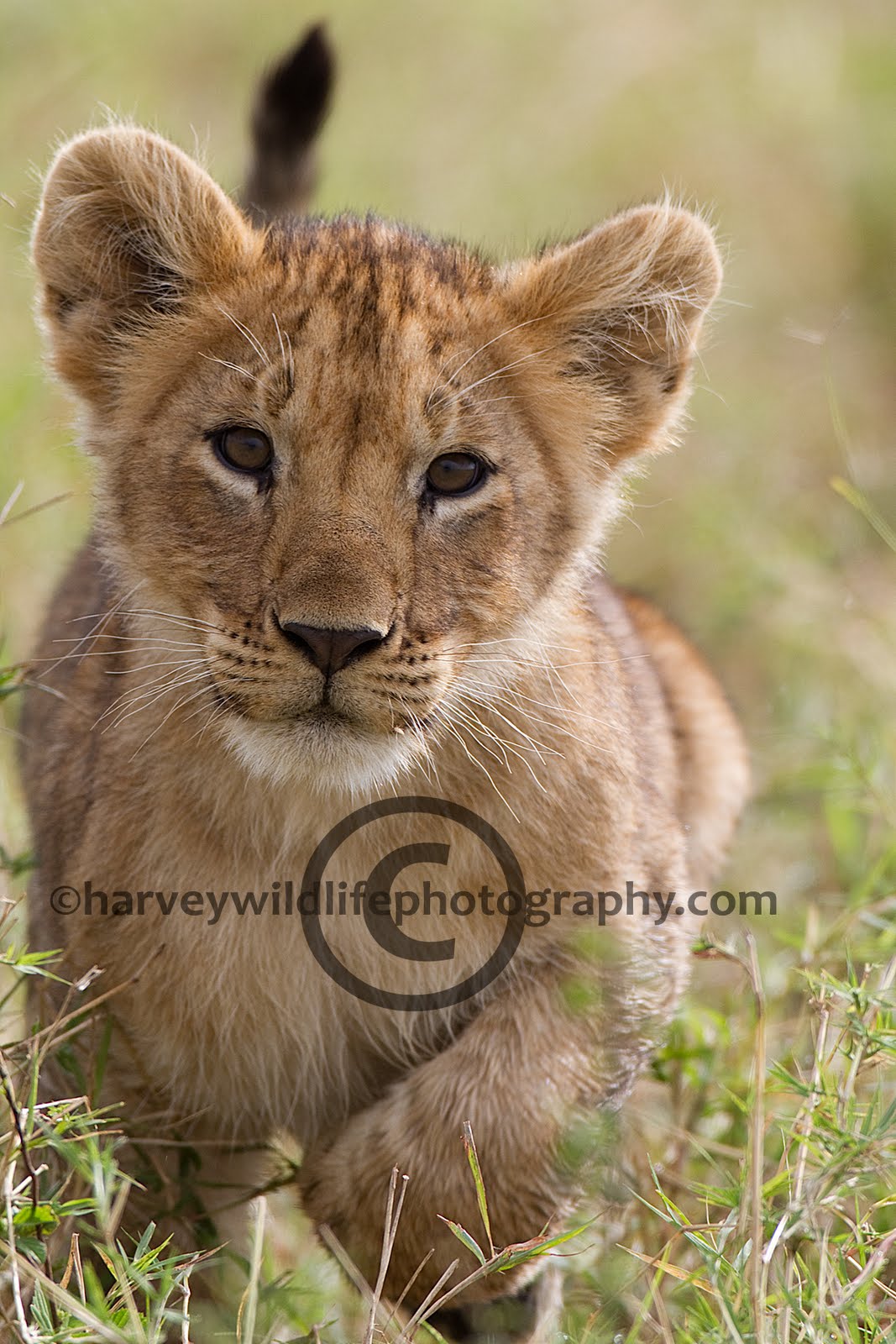
One of three of the youngest cubs
of the Marsh pride
                                 
There are three main prides of lions around Governor’s camps. They are the marsh pride, the paradise pride and the ridge pride. The marsh pride is only about a 7 minute drive from camp and they are the only pride with cubs, so we spent the entire first game drive photographing them. It's neat because the BBC is filming for their upcoming documentary 'The Truth about Lions'. It was great photographing the marsh pride with them. 


After lunch we went back to see them, but they were sleeping, so we decided to roam around elsewhere. Solomon noticed a thomson’s gazelle giving birth, so we stayed there for about an hour and a half. We watched her give birth, then clean up her baby. Unfortunately for her the baboons were on their way toward her so she had to leave the baby in hopes that she wouldn’t attract any attention. The baby was just behind a termite mound so she was hidden from them. A thomsons’ gazelle would be a nice light snack for a troop of baboons, so it was a bit nerve wracking for all of us for a while,  but instinctively, about 30 minutes later, the baby took its first wobbly steps and struggled to make it over to taller grass where it would be safe. From there we went back to check on the lions. There was overcast and it had gotten a little bit cooler, so the cubs awoke from their sleep and started to play. At the end of the day, my picture count was 3930.

6959 pictures to go...

Marsh pride lion cubs playing

Check out our main wildlife photography website and our main wildlife photography blog.
View pictures of the lions from Little Governors' Camp.

Day Nine: Travel to Nairobi, then on to Little Governors' Camp


September 10th...
We are over our allowable weight limit for baggage due to our photography equipment, so the airline attendant in charge of checking the weight of the bags sternly tells us that we are over our limit. “That will be $3 per kilogram over or $60. He then takes us aside so we can fill out our customs paperwork and tells us that we can buy him lunch and lunch is $20. I thought that was kind of funny. We gladly paid him the twenty bucks. Thankfully, the flights from Arusha to Nairobi and Nairobi to Little Governors’ camp are both in larger planes that are pressurized, so my nausea stays to a minimum. What a relief! We get into Little Governors’ camp where our guide Solomon is waiting for us. I specifically asked for him as a guide and right from the get go he was awesome! We had more fun, more conversation and learned more from Solomon in a short fifteen minute game drive into camp than we had learned from our previous Guide from Thomson’s in four days!
Boat ride across the Mara river to Little Governors' camp

I got a kick out of the look on Gaye’s face as we got closer to the camp. You get out of the land rover, then walk down these steps to the Mara river. At the bottom of the stairs is a man in a boat. There is a rope that goes across the river, so he just has to pull us across. As you are going across, you can see the hippos just upstream and downstream from our crossing. The first day she looked a little nervous, but we have to cross the river four times per day, so it gets comfortable quite quickly and just adds to the charm of the camp. Pictures to come soon...


Check out our main wildlife photography website and our main wildlife photography blog.
View pictures of the lions from Little Governors' Camp.
Sunday, September 12, 2010

Day Eight: Ngorongoro Crater, Masai Village Visit, travel to Arusha and Rivertrees Country Inn.

Vervet Monkey
Today we saw lots of lions again. We saw lions on a wildebeest kill, a small group of vervet monkeys, then a small herd of elephants in the forest. We got tired of driving around the barren wasteland,
so when I noticed the monkeys in the forest, I opted to watch and photograph them for an hour or so.

On the way out of Ngorongoro conservation area we stopped at a Masai village and were taken on a tour by the chief’s son. It started with a welcome dance and they insisted that we both dance with them. His father has 20 wives. The chief's son explained that when you have one wife, you have one problem. When you have twenty wives: 20 problems:) The chief's son was quite impressive. He was educated in Arusha and spoke very elequently.


Maasai Village Visit


After experiencing what we would call a more "civilized" society, he preferred living the Masai lifestyle. It was a pretty interesting tour as we were led into a hut and showed how they lived and cooked and slept. The structure of the hut is made with acacia tree branches. Each hut has a small main area that is used for cooking and a bedroom for the parents and a bedroom for the children. The roof of the hut is made with long grasses and the walls and the roof are cemented together with cow dung. The huts are quite sturdy and last for about 20 years. Each hut takes about 14 days to build.

The picture count for today is 739. 10,889 pictures to go...


Check out our main wildlife photography website and our main wildlife photography blog.
View pictures of elephants from Tarangire National Park.


Saturday, September 11, 2010

Day Seven: Ngorongoro Crater

To this point, I was looking forward to this as the highlight of the trip next to Little Governors’ Camp in Masai Mara. This is the reason that we came to Tanzania. Our camp is lush and green and beautiful. We get down the escarpment to the crater floor to discover a vast brown, dusty barren land. There are impressive herds of zebra and wildebeest, but you can’t drive off the roads, just like in other areas of Tanzania. It is understandable considering the amount of tourists here.


Affectionate Zebras

The problem is that unless the animals are right beside the road, your photo opportunities are quite limited. Our highlight of the day was watching a cheetah stalk and chase a thomson’s gazelle. She missed, but I did get a few pretty good shots of her. We also saw about 20 lions today and 20 or 30 hyenas. Early in the morning, we saw three lionesses and four lion cubs in the long grass devouring a wildebeest kill. The hyenas and jackals were standing by waiting for them to finish so they could clean up the scraps. The rest of the day we basically drove around dusty roads looking at the odd animal here and there way off in the distance. My lens and crop sensor camera reaches 960mm. The largest lens I saw anyone else with was a 400mm lens. I was having issues trying to get decent pictures today as most of the game was too far away. Gaye was bored stiff in about the first two and half hours. I think this place is highly over rated and will definitely not be back (after our three hour visit tomorrow morning of course). Even the alkaline lake with the flamingos is at least 150 meters away from the road. The roads in this park are not designed with easy access viewing! Oh well, I still managed to take 835 pictures. That would be a good hour and a half in pictures if the wildlife viewing was good. The good news is our peace de le resistance is coming. I saved the very best for last. Five days at Little Governors’ Camp is my dream safari.

11,628 pictures to go...


Check out our main wildlife photography website and our main wildlife photography blog.
View pictures of elephants from Tarangire National Park.

Day Six: Southern Tarangire and travel to Ngorongoro Crater

Today we drove the Southern portion of Tarangire. The terrain was completely different than the northern end. It was much prettier, although had fewer animals. I took about 300 pictures until noon when we had lunch and headed for our Ngorongoro Nyumba.


Baby elephant on a misson
Nogorongoro is a three hour drive. With our pit stops and souvenir stop, we ended getting in at around 5:30p.m. Driving up to the crater rim, the flora changes from barren and brown to green and lush and quite stunning. As we drove into camp, we were suddenly surrounded by these huge flat topped acacia trees. They look just like the setting from the movie Jurassic Park.


12,463 pictures to go...


Check out our main wildlife photography website and our main wildlife photography blog.
View pictures of elephants from Tarangire National Park.

Day Five: Tarangire National Park

Watering Hole

The vehicles in Tanzania are perfect for safari photography. The tops pop up so you can stand up in the vehicle, but are still shaded from the sun. It is quite ingenious.
Today was a great day for photography. We saw herds of zebra and waited for them at the river. We photographed literally hundreds of them as they passed through to drink. So far that was definitely the highlight of the safari. Tarangire is famous for their elephants. We saw hundreds of elephants, hundreds of Masai giraffe, hundreds of zebra, hundreds of baboons and basically a large diversity of animals.


When we got home from our safari today there were two huge elephant bulls in camp eating the trees about two tents down from ours. We were too dirty and too hungry to feel intimidated and after photographing hundreds of elephants in large herds today oddly enough we didn't really care. We had our showers and watched them as we waited for supper. You know you are on safari in Tanzania or Kenya when you go to sleep at night with animals like these outside your tent.

While we're on safari, safari comes to us
The picture count for today is 3517. Tomorrow we photograph in Tarangire in the morning, then at noon we leave for Ngorongoro Conservation area. Ngorongoro is ten miles wide, by twelve miles long. It is toted for being the most populated area for wildlife viewing on earth with 25000 to 30,000 animals.

12, 763 pictures to go...